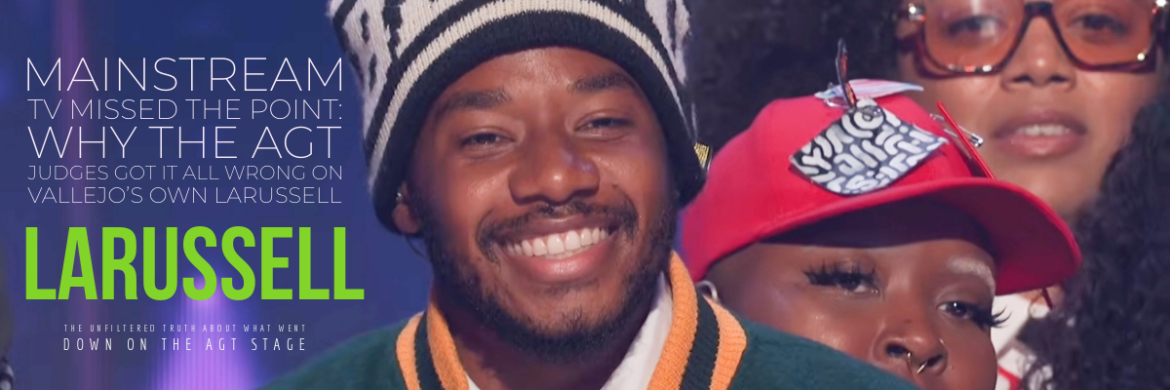

The Unfiltered Truth About What Went Down on the AGT Stage
When an established, independent trailblazer like LaRussell steps onto a national stage like America’s Got Talent, you expect a level of respect that matches what he has built. Hailing from Vallejo, California, LaRussell has done what few artists in modern music history have accomplished: he built an independent movement from the dirt up. Through his Good Compenny collective, he flipped the traditional music industry model on its head, famously hosting pay-what-you-want backyard shows, securing a partnership with Roc Nation, collaborating with heavyweights across the culture, and generating tens of thousands directly from his fans.

So when LaRussell brought a crew of talented local youth and community members out to deliver an uplifting, educational, high-energy hip-hop set, it wasn’t just a routine—it was a movement. But instead of recognizing the deep cultural value and raw, authentic energy on display, the panel delivered critiques that felt completely out of touch.
Breaking Down the Panel’s Reaction
With Simon Cowell absent from the panel, the remaining judges—Howie Mandel, Mel B, and Sofía Vergara—approached a seasoned master of his craft with basic corporate TV metrics:
- Howie Mandel: Handed down the harsher critiques of the night, going as far as to compare a community-driven hip-hop performance to a “high school routine.” Treating an artist of LaRussell’s caliber like an amateur needing more polish showed a total lack of understanding of authentic hip-hop performance style.
- Mel B: While she acknowledged what the group stood for and praised the high energy, she ultimately dismissed the set as “a bit chaotic.”
- Sofía Vergara: Appreciated the charisma, stage presence, and raw power LaRussell brought, but the overall panel sentiment still fell drastically short of giving the act its proper due.
The disconnect became even wider when watching how the rest of the show unfolded. Mainstream network TV routinely gives easy passes, standing ovations, and golden buzzers to novelty shock-value acts and dangerous stunts, yet picks apart a positive, lyrics-driven performance centered on empowering youth.

Mel B: Loved what his crew stands for and praised the high energy bouncing off the stage. However, she found the performance a bit chaotic and felt it needed a few more days of rehearsal.

Sofía Vergara: Disagreed with Mel B and praised LaRussell’s charisma and community focus, calling the performance a definite “step up from the audition”

Howie Mandel: Agreed that it was entertaining but criticized the production value. He stated that it felt more like a “high school musical recital” than a professional big-stage act
Simon Cowell missed the live show.
Was It a Setup Against an Independent Powerhouse?
Whether it was a deliberate corporate setup or just network TV chaos, the outcome produced the exact same result: an independent artist who built his own table got exposed to a panel that didn’t understand his model once his biggest advocate left the room.
Here is how that absence played directly into the narrative:
The Loss of the Industry Heavyweight: Simon Cowell understands music business infrastructure and independent leverage better than anyone on that panel. He recognized LaRussell’s movement during the audition because he knows what real organic traction looks like. Without Simon there to champion the Good Compenny ethos, the remaining judges evaluated a multi-platinum-level independent movement like a standard, polished TV novelty act.
The “Semi-Independent” Threat: Major network TV and corporate music structures thrive on complete control. An artist like LaRussell—who owns his masters, runs his own direct-to-consumer ecosystem, and secured a distribution deal with Roc Nation on his own terms—doesn’t fit the traditional AGT narrative of a hungry amateur waiting for a network deal to save them.
Critical Timing: Missing the live performance where LaRussell brought out local kids with an educational, positive message on “Dreams” left the decision entirely up to a casual TV voting base and judges who favor flashy, easily digestible spectacle (like aerial stunts).
Without Simon in that chair to validate the cultural weight of what LaRussell was doing, the show reverted back to standard network TV formulas: prioritizing cheap shock-value over authentic community impact.


The Missing Chair & The Systemic Shift
The Missing Executive Stamp: Simon Cowell’s Absence and the Live Show Shift
The disconnect on the live Quarterfinal stage becomes even more glaring when you look at how LaRussell’s AGT journey began. During his initial audition, it was Simon Cowell—the show’s executive producer and resident industry powerhouse—who gave LaRussell his flowers, openly stating that his high-energy, community-driven hip-hop was “exactly what the show needed.” Simon recognized the organic power of an artist who built his own empire from Vallejo to Roc Nation.
However, when critical live performance nights arrived, Simon was forced to miss the broadcasts due to surgery. His absence created a massive vacuum on the panel. Without the lead judge there to anchor the performance in its proper cultural context, the remaining panel—Howie Mandel, Mel B, and Sofía Vergara—defaulted to standard corporate TV metrics. They picked apart an empowering, educational set featuring local youth, reducing a masterclass in independent hip-hop to critiques about “rehearsal time” and “chaos.”
For an independent powerhouse operating on his own terms, Simon’s absence proved critical. Whether a coincidence of timing or a reflection of how network TV handles self-made artists who don’t fit their corporate mold, the result was the same: without his biggest advocate on the panel, the system pushed a multi-platinum tier artist aside in favor of circus-style spectacle.

The Quarterfinal Snub: Are the People Really Voting?


If there was any lingering doubt about the disconnect between mainstream television and real hip-hop culture, the Quarterfinal results made it plain as day.
Taking the stage with his original track “Dreams,” LaRussell transformed the AGT studio into an empowering showcase, bringing local youth from his community right to the center of national television. The message was clear, positive, and deeply rooted in uplifting the next generation.
Yet when the results were announced, LaRussell and the kids were eliminated. Moving on to the Semifinals instead was aerial pole acrobat Veronika Goroshkova.

The network claimed “the people voted.” But anyone tuning in with a pulse on culture has to ask: Are the people really voting, or is mainstream TV just pushing the narrative that fits their agenda? It defies logic that an established, highly respected independent artist bringing an educational, high-energy message with youth would get outvoted by a pole trick act.
Watching young kids pour their heart into a meaningful performance only to be sent home while novelty tricks take the green light highlights the fundamental flaw of network talent shows. They aren’t built for authentic culture or real community impact—they’re built for easy TV entertainment.
The results proved what independent creators have known all along. Network television can attempt to gatekeep, but they cannot dilute an artist who built his own table from the dirt up. LaRussell didn’t lose on that stage—the system showed its limitations. The Good Compenny movement was built in the streets, sustained by the people, and validated by years of independent success. No questionable network vote will ever take that away.
During Quarterfinals 2 on August 25, 2026, 10 other acts shared the America’s Got Talent stage alongside LaRussell
- Nene Royal – The singer and guitarist who won Mel B’s Live Golden Buzzer and automatically advanced to the finals.
- Geno Ploeger – A magician who performed an interactive close-up routine at the judges’ desk.
- Mackenzie Sol – A singer and social media content creator who performed “you broke me first”.
- Brad & Tracy – A danger duo act who took a terrifying risk using a chainsaw.
- Butter & Grit – A country-soul vocal duo who performed their original song “That’s Okay”.
- Come Here – A synchronized dance group from South Korea performing to Robyn’s “Indestructible”.
- Nyjah Music & Zyah Rhythm – A vocal duo who put a fresh spin on the song “I Swear”.
- Patrox – A dynamic dancer from Germany.
- Veronika Goroshkova – An aerial artist who performed to “The Fate of Ophelia”.
- Béty Dumitru – A vocalist who performed a cover of Sam Smith’s “Fire on Fire”.




LaRussell’s Heaven Sent is a bold and provocative track
LaRussell’s Heaven Sent is a bold and provocative track that has stirred wide conversation, raising questions about the risks and responsibilities that come with pushing boundaries in modern rap.
Overview and Context
LaRussell, a Vallejo artist recently signed to Jay‑Z’s Roc Nation, released Heaven Sent as part of a new project available on major streaming platforms. The song went viral after he named Donald Trump, Jeffrey Epstein, and Adolf Hitler as “heaven‑sent,” using the phrase to spark a larger discussion about the nature of good and evil. The attention has made him one of the Bay Area’s most talked‑about rising artists, especially following high‑profile moments like performing at the Super Bowl LX tailgate.
Reception and Controversy
The track triggered intense backlash online. Social media quickly filled with debates over whether LaRussell’s lyrics were meant as praise, shock value, or a deeper philosophical point. Clips of the song drew millions of views and thousands of comments. Critics questioned the ethics of placing figures like Hitler alongside other public personalities, while supporters argued that the song was meant to challenge listeners and provoke thought.
LaRussell later clarified that his message was about the full range of human behavior — that both admirable and terrible individuals are part of the same human story. His explanation, however, did not settle the controversy, and reactions remain sharply divided.

Artistic and Lyricist Lessons
Many commentators see Heaven Sent as a lesson in the power and risk of artistic freedom. The song shows how bold ideas can spark meaningful conversation, but also how easily a message can be misunderstood when dealing with sensitive historical or social topics. TikTok creators and other social media voices have used the track as an example of why clarity matters, especially when an artist chooses to provoke or challenge their audience.

Conclusion
Ultimately, Heaven Sent is a polarizing piece that has raised LaRussell’s profile while igniting debate. Its significance lies not only in its creative ambition but also in the conversations it has sparked about art, morality, and public perception. For listeners and aspiring artists, the track offers insight into the impact of controversial lyricism — its ability to captivate, unsettle, and inspire reflection.
LaRussell’s most famous song is “I’m From The Bay.”
“I’m From The Bay” is widely recognized as LaRussell’s signature track, garnering significant attention with 7.5K page views on Genius, reflecting its popularity among fans and listeners Genius. LaRussell, a rapper from Vallejo, California, is known for his authentic Bay Area style and is the founder of the Good Compenny collective, which has helped him build a dedicated fanbase through freestyles, performances, and collaborations
Grassroots Ownership vs. Mainstream Gatekeeping
LaRussell didn’t need America’s Got Talent to make him. This is an artist who turned down restrictive traditional deals to maintain full control of his intellectual property and build an empire alongside his friends and family. From performing in his Vallejo backyard to packing venues and performing at the Super Bowl LX Tailgate Party and NBA All-Star Game, his foundation is rock solid.
For mainstream judges to act oblivious to his impact or judge his community-focused art through a watered-down talent show lens proves how broken commercial television gatekeeping really is. LaRussell didn’t fail to hit the mark—the judges failed to realize what they were standing in front of.
You don’t need a gold buzzer when you already have the respect of the streets, the backing of your community, and a catalog of hits that speaks for itself.









From the Dirt Up: How LaRussell Got His Start

LaRussell’s music career wasn’t handed to him through a high-powered record deal or instant internet viral fame; it was forged through real life, sacrifice, and relentless work ethic in Vallejo, California.
- The Early Spark: Born LaRussell Dwayne Thomas, his connection to music started early, writing his first rhymes back in the second grade, heavily inspired by his father.

- Prioritizing Family Over Fame: After graduating high school, LaRussell became a father to his first daughter. Recognizing his responsibility to provide, he put his full-time musical dreams on hold. He took on a high-paying job in aerospace manufacturing, holding down a steady career for six years while quietly grinding on his craft on the side—releasing music under his early rap moniker, Tota.
- The Leap of Faith: In 2018, feeling unfulfilled in the corporate world, LaRussell took a massive gamble on himself. He quit his aerospace job, pooled together savings, and stepped into music full-time. With initial backing from his father, friends, and family, he threw a successful headlining show at Vallejo’s Empress Theatre, proving to himself and his city that the demand was real.
- Rebranding and the Birth of Good Compenny: By 2019, he officially launched Good Compenny with his close team, moving away from his stage name Tota to perform under his real name, LaRussell. Dropping his defining album Silence Won’t Save You in 2020, he stripped away the typical flashy rap tropes—opting for hoodies, Crocs, and raw honesty.
LaRussell’s debut album is The Field Effect, which was released on January 25, 2018
Genius. At the time, he was performing under the name Tota Shakur before adopting his current mononym.
LARUSSELL

Sophie Cunningham is rumored to be released by the Indiana Fever. Fans react
Sophie Cunningham may be finding a new team soon!


According to rumors, the WNBA star she might “released” by Indiana Fever at the end of the season. She has been making headlines recently, especially due to the comments she made in July about protecting young girls from competing against biological males in women’s sports


The Game’s wild comeback just reignited his Kendrick Lamar beef
The Game is back in the spotlight with The Documentary III, a massive 24-track project featuring Drake, Snoop Dogg, Lil Wayne, Ye, and more. But it’s his nods to Kendrick Lamar, Drake, and the infamous GNX that have hip-hop fans buzzing, with many convinced the Compton rapper is siding with Drake. Despite the chatter, The Game insists he didn’t diss anyone and says his mentions of Kendrick are “all love.” His attempts to clear the air have only fueled more speculation, especially after his manager Wack 100 hinted that Kendrick and The Game could face off in the studio. With Kendrick’s crew already responding, this surprise comeback might have just reignited one of hip-hop’s biggest rivalries.